
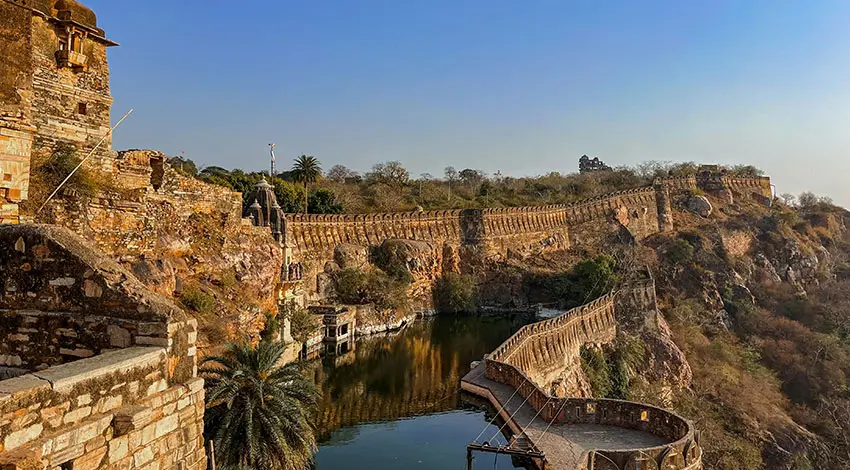
Quick answer: Chittorgarh Fort is India's largest fort by area - roughly 280 hectares (about 692 acres) spread across a 180-metre-high hill in southern Rajasthan, with a 13 km outer wall, seven fortified gates and 65 surviving historic structures. It was the capital of Mewar for over 800 years, was inscribed on the UNESCO World Heritage list in 2013 as part of the Hill Forts of Rajasthan, and sits about 115 km (2 to 2.5 hours by road) from Udaipur - making it the single best full-day heritage excursion from the lake city.
| Location | Chittorgarh, southern Rajasthan, India |
| Distance from Udaipur | ~115–120 km · 2 to 2.5 hours by car |
| Built / expanded | 7th century onwards; major expansion under Rana Kumbha (1433–1468) |
| Area | ~280 hectares (≈692 acres) - largest fort in India |
| Wall circumference | ~13 km · fort length ~5 km · hill height ~180 m |
| UNESCO status | World Heritage Site since 2013 (Hill Forts of Rajasthan) |
| Timings | Approx. 9:00 AM – 5:00 PM, open all seven days |
| Entry fee (indicative) | ~₹40 Indian nationals · ~₹600 foreign nationals (ASI rates - confirm at the counter) |
| Light & Sound Show | Evenings, seasonal timing · ~₹150 Indian / ~₹300 foreign + GST (RTDC) |
| Time needed | 3–5 hours inside the fort |
| Best time to visit | October to March |
| Managed by | Archaeological Survey of India (ASI) |
Please note: Ticket prices, show timings and opening hours are revised periodically by the ASI and RTDC. The figures above are indicative for 2026 - our team reconfirms them for every guest before departure.
Most travellers arrive in Rajasthan with a mental image built from Jaipur's pink facades and Udaipur's lakes. Chittorgarh offers something harder and older: an entire fortified city, largely in ruins, where the defining events were not celebrations but sieges.
This is the difference worth understanding before you go. Udaipur represents the later glory of Mewar - the lakes, the marble palaces, the courtly refinement that followed. Chittorgarh represents the earlier chapter, when the same dynasty defended its independence against the Delhi Sultanate, the Sultanate of Gujarat and finally the Mughal Empire. Visit Chittorgarh first and Udaipur reads completely differently: you understand why the Sisodias moved their capital to a valley ringed by hills in 1559.
Unlike forts remembered mainly for their architecture, Chittorgarh is remembered for what happened inside it. Three sieges, three mass sacrifices, and a set of names - Rana Kumbha, Rani Padmini, Rani Karnavati, Mirabai, Panna Dhai, Jaimal and Patta - that remain part of Rajasthan's living cultural memory nearly five centuries later.
It is also, simply, enormous. At roughly 692 acres it is the largest fort in India by area, and the only way to experience it properly is with a vehicle inside the complex and a guide who can connect the ruins to their stories.
The founding
Tradition credits the earliest fort to Chitrangada Mori, a 7th-century Mauryan chieftain, after whom the site was originally called Chitrakut. Around 728–734 CE the fort passed to Bappa Rawal of the Guhila (later Sisodia) dynasty - either by conquest or, in another version, as a dowry. Whichever account you prefer, from that point on Chittorgarh and Mewar become a single story.
The location explains everything. The fort sits on an isolated plateau rising about 180 metres above the plains, at the point where routes between northern and western India converge. From the ramparts you can see approaching armies hours before they arrive. Water - 84 water bodies were engineered here, of which around 22 still function, holding roughly four billion litres - meant the fort could theoretically sustain a garrison of 50,000 for years.
The golden age under Rana Kumbha
The fort's architectural peak came under Maharana Kumbha (r. 1433–1468), arguably Mewar's most consequential ruler. He was a soldier, a builder, a musicologist and a patron of Sanskrit literature. Under him the seven gates were fortified, palaces expanded, temples endowed and the Vijay Stambh raised. Chittorgarh in this period was not a garrison - it was a capital city with a court, a religious establishment and a population.
The three sieges
| Siege | Year | Attacker | Mewar ruler | Outcome |
| First | 1303 | Alauddin Khalji (Delhi Sultanate) | Ratan Singh | Fort captured after ~8 months |
| Second | 1535 | Bahadur Shah of Gujarat | Vikramaditya Singh (Rani Karnavati regent) | Fort captured |
| Third | 1567–68 | Emperor Akbar (Mughal) | Udai Singh II (defended by Jaimal & Patta) | Fort fell 23 February 1568 |
After Akbar's siege, Udai Singh II shifted the Mewar capital to the city he had founded in 1559 - Udaipur. Chittorgarh was formally returned to Mewar under a treaty with Jahangir in 1616, but it was never re-occupied as a capital. What survives today is essentially a 16th-century city frozen at the moment it was abandoned.
Why it is a UNESCO World Heritage Site
In 2013, at the 37th session of the World Heritage Committee in Phnom Penh, Chittorgarh was inscribed on the UNESCO World Heritage List as one of six components of the serial property Hill Forts of Rajasthan - alongside Kumbhalgarh, Ranthambore, Amber, Jaisalmer and Gagron. The citation recognises the forts as an outstanding example of Rajput military hill architecture, and specifically the way Chittorgarh integrated defence, water engineering, palaces, temples and a functioning urban settlement within one wall.
Discover the legendary history, grand palaces, victory towers, and temples of Chittorgarh Fort with a private luxury car and expert heritage guide. Enjoy a comfortable, flexible day trip from Udaipur.
No account of this fort is complete without addressing the events that made its name. Jauhar was the practice in which, when defeat became certain, the women of a besieged Rajput fort chose collective self-immolation rather than capture, while the men rode out in saka - a final, deliberately unsurvivable charge.
Chittorgarh is associated with three such events:
An annual Jauhar Mela, held in the spring month of Chaitra, commemorates these events and draws Rajput families from across the region. If your travel dates fall near it, the fort takes on an entirely different, deeply emotional atmosphere.
We include this history because it is central to the site - but we present it as history, with its uncertainties intact, rather than as spectacle. A good guide will do the same.
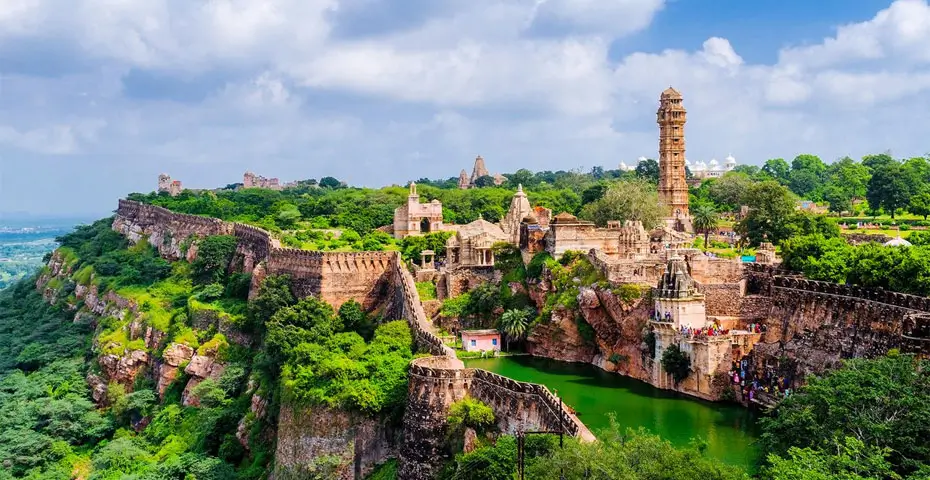
Chittorgarh is best understood as a fortified city, not a building. The numbers make the point:
The design logic is layered defence. The approach road climbs in switchbacks so that attackers are exposed to fire from above for the entire ascent; each gate is set at an angle so that battering rams cannot build momentum; the gates have overhanging parapets from which defenders could drop stones and hot oil. Inside, the structures spread out along a central spine, with reservoirs distributed so that no single sabotage could cut the water supply.
What makes Chittorgarh architecturally unusual is the coexistence of that military hardness with genuine artistic ambition. The Vijay Stambh is one of the most intricately carved freestanding towers in India. The Jain temples carry some of the finest 15th-century stone work in Rajasthan. The palaces, even ruined, show canopied balconies and courtyards designed for court life rather than siege.
Practical implication: you cannot walk this fort end to end in a morning. Plan on driving between clusters of monuments and walking within each cluster.
The ascent passes through seven gates, most of them fortified under Rana Kumbha. In order, from the base upward:
Ask your guide to stop at Bhairon Pol and Padan Pol rather than driving past them. The chhatris (cenotaphs) beside these gates mark where specific defenders died, and they are the point at which the fort's history stops being abstract.
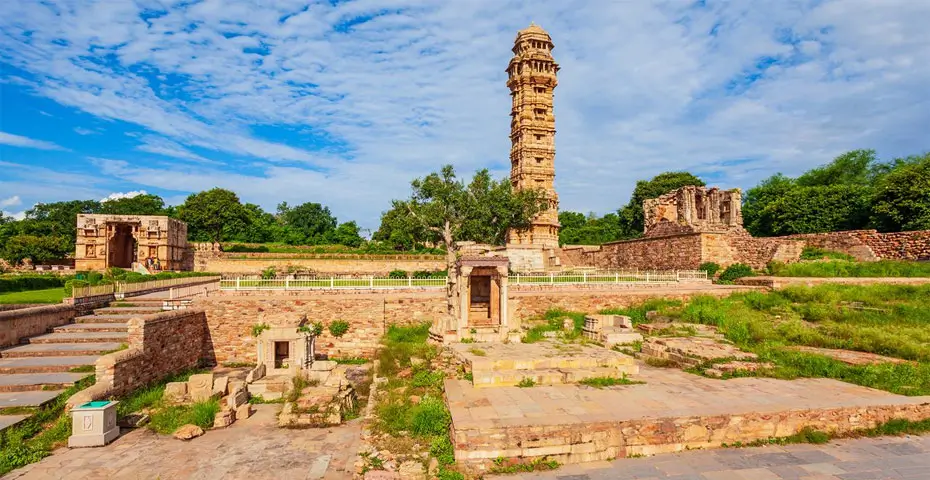
The Vijay Stambh is the fort's signature monument and appears on Rajasthan's tourism iconography for good reason.
| Detail | Fact |
| Built by | Maharana Kumbha |
| Period | Mid-15th century (c. 1458–1468) |
| Commemorates | Victory over Mahmud Shah I Khalji of Malwa (1440) |
| Height | 37.2 m (122 ft) |
| Storeys | 9 |
| Interior staircase | 157 steps |
The exterior is covered, tier by tier, in sculpture: Hindu deities, court figures, musicians, dancers, weapons and inscriptions. Read as a whole, it functions as a carved encyclopaedia of 15th-century Mewar - its religion, its army, its court and its self-image.
The narrow internal staircase can be climbed to the eighth level. The view from the top is the single best way to grasp the scale of the fort - you see the full plateau, the reservoirs and the plains beyond.
Tip: the staircase is steep, unlit in places and can feel confined. Guests with mobility limitations or claustrophobia are better served by photographing the tower from the terrace and spending the time at the neighbouring Kumbha Shyam and Meera temples instead.
Best light: early morning (roughly 8:30–10:00 AM) or the last hour before closing, when low sun brings out the relief carving.
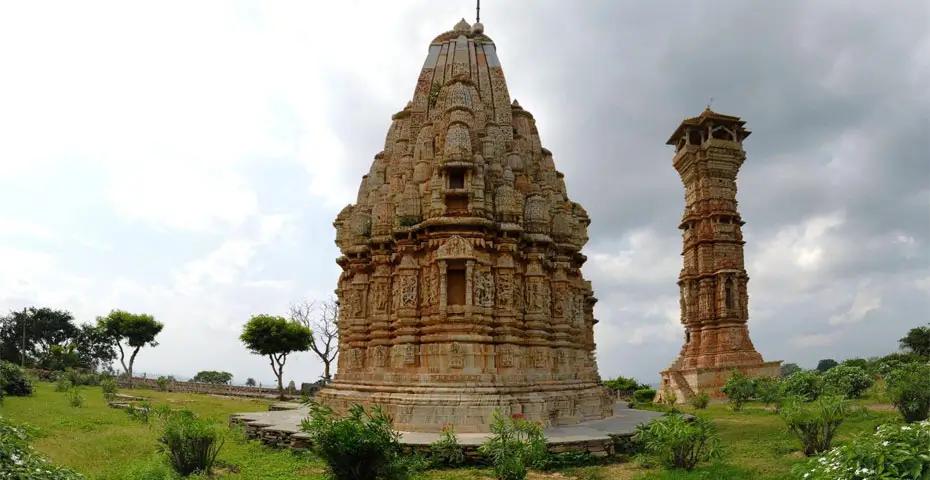
Older and smaller than its famous neighbour, the Kirti Stambh is the more surprising monument of the two.
The tower is carved with figures of the Tirthankaras and Jain iconography, and a 15th-century pavilion was later added at the top. Its presence matters historically: a Jain merchant financed a monumental tower inside the capital of a Hindu Rajput kingdom, and it stands to this day. That tells you something real about the religious plurality of medieval Mewar that no palace can.
Nearby stand the Sat Bis Deori Jain temple group, worth twenty minutes for the carving quality alone.
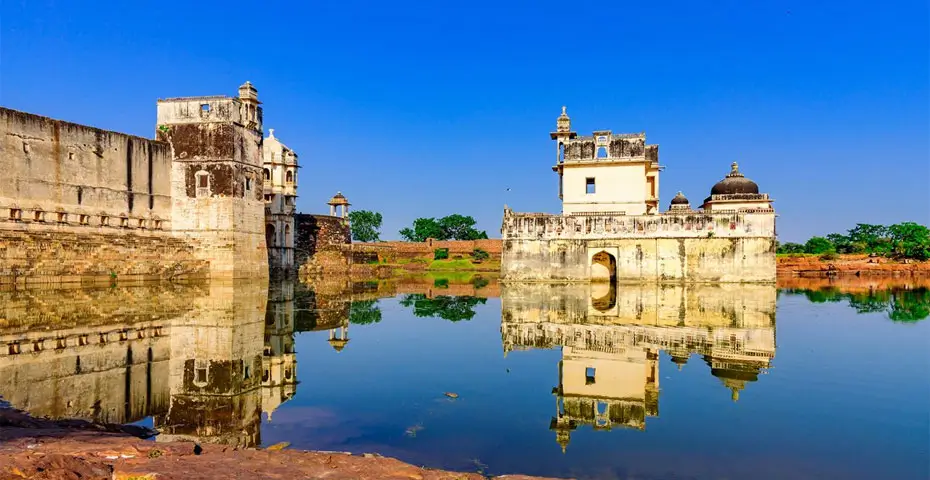
This is the most visited and most misunderstood structure in the fort.
What you see: a white, three-storeyed pavilion set in the middle of a water tank in the southern part of the fort, crowned with chhatris. It is elegant, photogenic and an early example of the "Jal Mahal" (water palace) idea that later spread across Rajasthan.
What visitors are told: that Alauddin Khalji was permitted to see the queen's reflection in a mirror from an adjacent chamber, and that her beauty triggered the siege of 1303.
What historians say: the Padmini narrative first appears in the Padmavat, an epic poem composed by the Sufi poet Malik Muhammad Jayasi in 1540 - more than 230 years after the siege. There is no contemporary 14th-century evidence for the queen or the mirror episode. The siege of 1303 is historical fact; the romance attached to it is literary. Adding to this, the structure standing today is largely a 19th-century reconstruction, not the original 13th-century building.
None of this makes the palace less worth visiting. It makes it more interesting - you are standing at the point where history, poetry and 19th-century restoration meet, and where a story became more powerful than the record it grew from. Travellers consistently tell us this honest version is the more memorable one.
Step into the fascinating history of Mewar with a personalized Chittorgarh excursion from Udaipur. Travel in comfort with a private chauffeur, knowledgeable guide, and carefully planned heritage sightseeing.
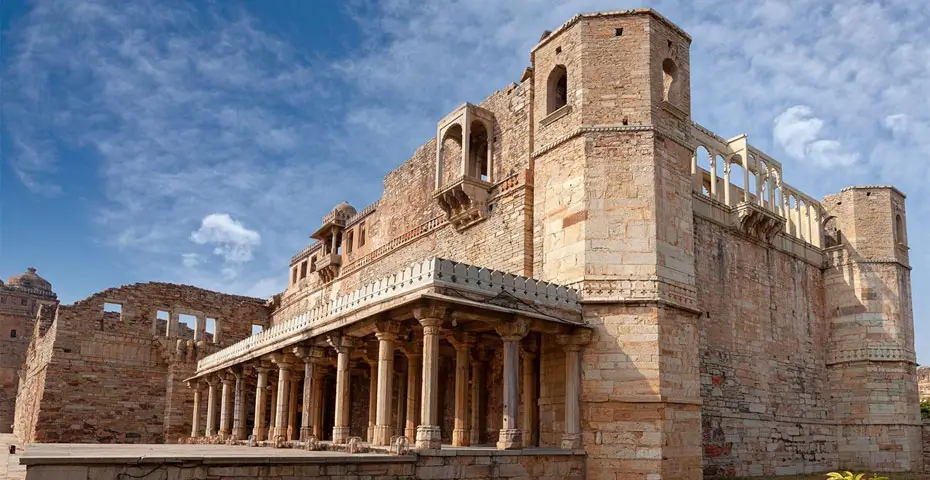
Entered through the Suraj Pol, the Rana Kumbha Palace is the oldest surviving palace complex in the fort and, though ruined, the most atmospheric. What remains - plastered stone walls, canopied balconies, stables, a stepwell, underground chambers and the Kanwar Pade Ka Mahal built for the crown prince - sketches out a full royal household.
Two associations make it the emotional centre of the fort:
Mirabai lived here. The poet-saint's chambers were within this complex before she left the court entirely.
Panna Dhai's sacrifice happened here. In the 1530s, when the usurper Banbir moved to kill the infant heir Udai Singh II, his nursemaid Panna Dhai substituted her own son in the prince's bed and smuggled Udai Singh out in a fruit basket. Her son was killed. Udai Singh survived, became Maharana, and founded Udaipur in 1559.
That is the connection most day-trippers never hear: the city you are staying in exists because of a decision made in these ruins. Ask your guide to tell this story on site - it is what turns a walk through rubble into the most affecting twenty minutes of the day.
Adjacent additions include the Ratan Singh Palace (c. 1528–1531) and Fateh Prakash Palace / Badal Mahal (late 19th–early 20th century), the latter now housing a government museum with sculpture, arms and local antiquities. The museum is small but a good air-conditioned pause in warmer months.
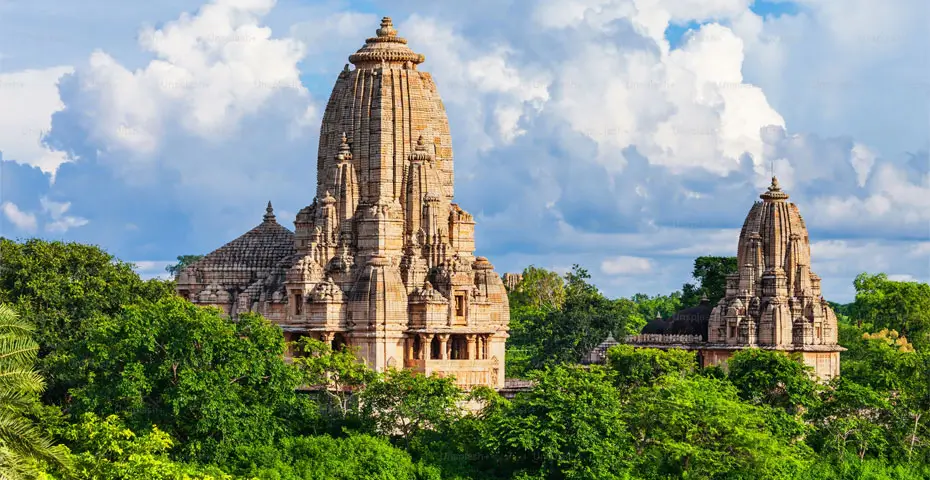
Chittorgarh is remembered for battles, but it was equally a centre of devotion - and the Meera Temple is where that side becomes tangible.
Mirabai (c. 1498–1546) was a Rajput noblewoman by marriage and a Krishna devotee by conviction. She abandoned court protocol, sang and danced in public temples, composed bhajans in Rajasthani and Braj that are still sung across India, and ultimately left Mewar altogether. Her poetry survives; her royal status is a footnote.
The temple, built during Rana Kumbha's reign, is a compact but finely proportioned structure in the ornate Indo-Aryan style, with carved pillars, a sanctum and a small shrine. Beside it stands the larger Kumbha Shyam Temple (also called the Varaha Temple, 1448), with a distinctive pyramidal spire.
For visitors, this pair provides the necessary counterweight to the sieges. Chittorgarh was not only a place where people died defending walls - it was a place where a woman walked away from all of it and became the more lasting figure.
Gaumukh Reservoir - A spring-fed tank at the cliff edge, fed through a carved cow's-mouth spout. This was the fort's insurance policy during sieges. It is also the quietest, coolest spot in the complex and offers a dramatic drop-off view over the plains. Fish and pigeons; bring nothing to feed them.
Kalika Mata Temple - Originally an 8th-century Sun temple, later rededicated to the goddess Kali. One of the oldest structures in the fort and an active place of worship, so dress and behave accordingly.
Sat Bis Deori & Shringar Chauri - Mid-15th-century Jain temples with exceptionally dense carving. Under-visited and worth the detour.
Bhamashah Haveli & Jaimal-Patta Havelis - Ruined mansions that show how the fort's nobility, not just its rulers, lived.
Samadhishwar Temple - A large 11th-century Shiva temple near Gaumukh, notable for its three-faced Shiva image.
Chittorgarh's living population - Around 3,000–5,000 people still live inside the fort walls, with a school, shops and homes. It is not a museum site; it is an inhabited historic town. Photograph residents only with permission.
Opening hours
| Fort open | Approx. 9:00 AM – 5:00 PM, all seven days |
| Museum (Fateh Prakash) | Usually closed on Fridays and public holidays |
| Recommended arrival | Before 10:00 AM |
Entry fee (indicative, 2026)
| Category | Fee |
| Indian nationals | ~₹40 |
| Indian students (with ID) | ~₹25 |
| Foreign nationals | ~₹600 |
| Still camera | Generally free; video and drone charges/restrictions apply |
| Museum | Separate small ticket |
Tickets are managed by the Archaeological Survey of India and can also be booked online via the ASI portal. Drones require prior written permission and are otherwise prohibited.
Light & Sound Show
The RTDC-run evening show covers the founding of the fort, its rulers, the Khalji siege and the Gaura-Badal and Padmini narratives, using DMX-controlled LED lighting and 5.1 surround audio.
| Indian tourist | ~₹150 (+18% GST) |
| Indian student / child | ~₹75 (+GST) |
| Foreign tourist | ~₹300 (+GST) |
| Foreign student / child | ~₹150 (+GST) |
| Timing | Evening; typically between 6:30 PM and 7:30 PM depending on season |
Important for day-trippers: the show ends after dark, and the drive back to Udaipur is roughly 2 to 2.5 hours on a highway with mixed night traffic. If the show matters to you, we recommend an overnight stay in Chittorgarh or Bijaipur rather than a late return. Our team will advise on this when planning your itinerary.
Always reconfirm current rates and timings before travel - ASI and RTDC revise them periodically.
Combine Udaipur’s royal elegance with the historic grandeur of Chittorgarh Fort. Enjoy private transportation, expert local guidance, flexible sightseeing, and a seamless heritage experience.
By road
| From | Distance | Driving time |
| Udaipur | ~115–120 km | 2 – 2.5 hours |
| Bundi | ~160 km | 3 hours |
| Jaipur | ~305 km | 5.5 – 6 hours |
| Jodhpur | ~330 km | 6 hours |
| Ahmedabad | ~370 km | 6 hours |
| Delhi | ~570 km | 9 – 10 hours |
The Udaipur route runs via NH 48 (formerly NH 76/79) - a good four-lane highway through open Mewar countryside with wheat and mustard fields, small temples and roadside dhabas. It is one of the more pleasant drives in Rajasthan.
By train
Chittorgarh Junction (COR) is a well-connected station on the Delhi–Ajmer–Udaipur and Kota–Ratlam lines, with direct services from Udaipur, Jaipur, Delhi, Kota, Ahmedabad and Mumbai. The station is about 6 km from the fort entrance. The Udaipur–Chittorgarh rail journey takes roughly 2 to 3 hours depending on service.
By air
Maharana Pratap Airport, Udaipur (UDR) is the nearest airport, about 90–100 km from the fort, with connections to Delhi, Mumbai, Jaipur and other metros. Most international guests fly into Delhi or Mumbai and continue to Udaipur.
This is the practical point most guides omit: the fort is far too large to walk. A vehicle is permitted on the internal road, and you drive between monument clusters, walking within each. Auto-rickshaws are available at the base for independent travellers; a private car with a driver who knows the internal circuit is considerably more comfortable and lets you sequence stops to follow the light.
If your visit is part of a longer Rajasthan journey, a private car and chauffeur across India removes the ticketing, parking and guide-arrangement friction entirely.
A realistic, road-tested schedule for a private full-day excursion:
| Time | Plan |
| 07:30 | Depart your Udaipur hotel after breakfast |
| 07:30 – 09:45 | Drive via NH 48; one comfort stop en route |
| 09:45 – 10:15 | Arrive; ascend through the seven gates, stopping at Padan Pol and Bhairon Pol |
| 10:15 – 11:15 | Rana Kumbha Palace complex - Panna Dhai and Mirabai stories; Fateh Prakash museum |
| 11:15 – 12:15 | Vijay Stambh, Meera Temple and Kumbha Shyam Temple |
| 12:15 – 13:00 | Gaumukh Reservoir and Samadhishwar Temple |
| 13:00 – 14:00 | Lunch - hotel restaurant in town or a curated heritage property |
| 14:00 – 15:00 | Rani Padmini Palace and Kalika Mata Temple |
| 15:00 – 15:45 | Kirti Stambh and the Sat Bis Deori Jain temples |
| 15:45 – 16:15 | Free time on the ramparts for photography |
| 16:15 | Depart for Udaipur |
| 18:30 – 19:00 | Arrive back in Udaipur |
Two-day variation: stay overnight at a heritage property near Chittorgarh or at Bijaipur, attend the Light & Sound Show, and return the next morning via Menal or the Bassi Wildlife Sanctuary. This is the version we recommend to photographers and to guests travelling with older parents, since it removes the long same-day drive.
Route variation: rather than returning to Udaipur, many travellers use Chittorgarh as a natural stop on the Udaipur - Chittorgarh - Bundi - Jaipur road journey, which turns a backtrack into forward progress. Our Rajasthan tour packages are frequently built around exactly this routing.
| Season | Months | What to expect |
| Peak (best) | October – March | 10–27 °C. Clear light, comfortable walking, ideal photography. The right window for most travellers. |
| Shoulder | March – April | Warming but manageable; fewer crowds. Jauhar Mela usually falls in Chaitra (Mar/Apr). |
| Hot | May – June | 38–45 °C. Very demanding on foot. Visit only 6:30–9:30 AM or after 4:30 PM, with water and sun protection. |
| Monsoon | July – September | Green landscape, dramatic skies, excellent photography. Stone surfaces get slippery; occasional interruptions. |
Best time of day: the first two hours after opening and the last ninety minutes before closing. Midday flattens the carving detail and, from March onwards, the plateau holds heat with almost no shade.
Crowd note: weekends and Indian public holidays bring domestic crowds. A weekday visit in December or January is close to ideal.
Kit notes: a wide lens (16–35 mm equivalent) does most of the work; the towers are tall and the courtyards tight. A polariser helps in the harsh midday sky. Tripods are generally tolerated in open areas but not inside active temples. Drones are prohibited without prior written permission.
Do
Avoid
Accessibility: the fort is drivable, which helps considerably, but individual monuments involve steps and uneven ground, and the Vijay Stambh staircase is steep and narrow. For guests with limited mobility, a well-planned circuit of Rana Kumbha Palace, the temple cluster, Gaumukh and Padmini Palace delivers most of the experience without difficult climbs. We plan these routes routinely - see our notes on travelling in India with elderly parents.
Both are UNESCO-listed Hill Forts of Rajasthan; both are day trips from Udaipur; travellers with only one spare day ask this constantly.
| Chittorgarh | Kumbhalgarh | |
| Distance from Udaipur | ~115 km · 2–2.5 hrs | ~85 km · 2–2.5 hrs |
| Defining feature | Largest fort in India; 800 years of Mewar capital history | 36 km perimeter wall - among the longest in the world |
| Condition | Extensive ruins with major standing monuments | Better preserved; dramatic ramparts |
| Terrain | Flat plateau, drivable | Hilly, more walking and climbing |
| Emotional weight | Very high - sieges, jauhars, Mirabai, Panna Dhai | Moderate - Rana Kumbha's birthplace, military scale |
| Best for | History, storytelling, architecture, temples | Landscape, walls, walking, dramatic views |
| Often combined with | Bundi, Menal, Bijaipur | Ranakpur Jain Temple, Haldighati |
Short answer: choose Chittorgarh if you came to Rajasthan for its history and want to understand Mewar. Choose Kumbhalgarh if you want spectacle, ramparts and a walk with a view - and pair it with Ranakpur. With three days from Udaipur, do both.
Sanwariya Ji Temple (~40 km) - a major Krishna shrine drawing large pilgrim crowds, particularly on Amavasya.
Menal (~90 km) - an 11th–12th-century temple complex beside a seasonal waterfall, once described as the "Khajuraho of Mewar." Almost no foreign tourists; excellent carving.
Bassi Wildlife Sanctuary (~25 km) - dry deciduous forest with leopard, antelope and prolific birdlife. Good for an early morning before the fort.
Bijaipur (~40 km) - a 16th-century castle now run as a heritage hotel, and the most comfortable overnight base in the region.
Nagari (~15 km) - an ancient settlement site (Madhyamika) with archaeological remains dating to the Mauryan and Gupta periods. For the genuinely history-minded.
Extended routes worth considering
If you're mapping a full state itinerary, our Rajasthan forts and palaces tour and the Udaipur travel guide are the natural next reads.
Most travellers base themselves in Udaipur and treat Chittorgarh as a day excursion. If you are staying at The Oberoi Udaivilas, Taj Lake Palace, The Leela Palace Udaipur, RAAS Devigarh or a similar property, a private chauffeured excursion with an expert heritage guide is straightforward to arrange, with a packed breakfast for the early departure.
Staying near Chittorgarh makes sense if you want the Light & Sound Show, sunrise photography, or a break in a long road journey. Options range from Castle Bijaipur (heritage, ~40 km) to comfortable business-standard hotels in Chittorgarh town. There are no luxury properties of Udaipur's calibre in Chittorgarh itself - worth setting expectations on.
Eating: food inside the fort is limited to basic stalls. Plan lunch in Chittorgarh town or, better, arrange a heritage-property lunch. Local Mewari specialities worth trying include dal baati churma, gatte ki sabzi and ker sangri. For international guests, we brief properties on dietary requirements in advance.
Yes - particularly if you are interested in history rather than only architecture. It is India's largest fort, a UNESCO World Heritage Site, and the setting for eight centuries of Mewar history. With a good guide and at least three hours, most travellers rate it among the highlights of their Rajasthan journey.
About 115–120 km, roughly 2 to 2.5 hours by road via NH 48. It is the most practical full-day heritage excursion from Udaipur.
Three to five hours inside the fort. Under three hours means seeing only two or three monuments out of more than sixty.
Approximately 9:00 AM to 5:00 PM, seven days a week. Arriving before 10:00 AM is strongly recommended. Confirm current timings before travel, as they are revised periodically.
Indicatively around ₹40 for Indian nationals and ₹600 for foreign nationals, with a reduced student rate. Tickets are issued by the Archaeological Survey of India and can also be booked online. Rates change — reconfirm before your visit.
Yes. The fort has an internal road and vehicles are permitted. Given that the complex covers nearly 700 acres, driving between monument clusters and walking within them is the only realistic way to see it.
For three things: it is the largest fort in India by area; it was the capital of Mewar for over 800 years; and it withstood three major sieges - by Alauddin Khalji (1303), Bahadur Shah of Gujarat (1535) and Emperor Akbar (1567–68) - each ending in a jauhar that entered Rajasthani cultural memory.
A guide is highly recommended because the fort's importance comes from its historical stories and cultural significance.
Yes. It was inscribed in 2013 as one of six components of the serial property "Hill Forts of Rajasthan."
Chittorgarh Fort, at approximately 280 hectares (692 acres), with a wall circumference of about 13 km.
The siege of 1303 is historical. The Padmini narrative comes from the Padmavat, a poem composed by Malik Muhammad Jayasi in 1540 — more than two centuries after the event — and its historicity is debated by historians. The palace standing today is largely a 19th-century reconstruction.
37.2 metres (122 feet), across nine storeys, with an internal staircase of 157 steps. It was built by Maharana Kumbha to commemorate his 1440 victory over Mahmud Khilji of Malwa.
October to March, for comfortable temperatures and good light. Within the day, the first two hours after opening or the last ninety minutes before closing.
Yes, an RTDC-run evening show covering the fort's history and the Padmini and Gaura-Badal narratives. Indicative rates are ~₹150 for Indian and ~₹300 for foreign visitors, plus GST. Because it ends after dark, an overnight stay is advisable rather than a late drive back to Udaipur.
Not comfortably. They lie in different directions from Udaipur and each deserves a half to full day. Plan them as two separate excursions.
Yes - roughly 3,000 to 5,000 residents live within the walls, with a school, shops and homes. It is an inhabited historic town, not only a monument.